
Remuneration Structure and Elements
a) Overview
The total remuneration payable to the members of the Executive Board is composed of fixed and variable elements. The fixed remuneration, which is not tied to performance, comprises the base remuneration plus ancillary benefits. The variable remuneration is composed of a short-term variable bonus with annual targets (Annual Bonus) and a long-term variable bonus (LTP). In addition, the members of the Executive Board may be offered a reappointment bonus (which may also be tied to performance).
The serving members of the Executive Board do not receive any pension commitments financed by the company. Executive Board members can decide in individual cases to convert their variable remuneration into a defined contribution benefit commitment.
Remuneration Components of the Remuneration System as of 2025
As a rule, the relative share of the base remuneration, on the one hand, and the short-term and long-term variable remuneration, on the other hand, break down as follows (including regular benefits but excluding any secondment-related benefits and reappointment bonuses):
Relative Shares of the Remuneration Components
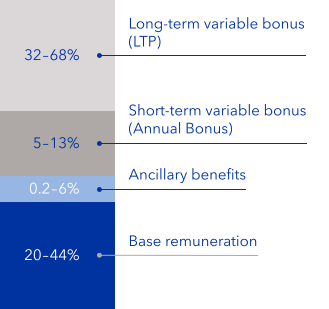
In this description of the relative shares, components of the LTP are included with an annual target value on a prorated basis, notwithstanding the fact that they are not due for payment until the end of their respective period. Particularly regarding long-standing members of the Executive Board with higher target remuneration overall, the share of long-term variable remuneration may be above the relative shares presented in some cases. If a member of the Executive Board is granted a reappointment bonus, this is generally up to 50% of the annual target total remuneration at the beginning of the appointment period. The secondment-related benefits may equal an amount of up to 100% of the base remuneration depending on the location (see c) below for ancillary benefits). The relative shares accounted for by the other remuneration components are modified correspondingly in these cases.
The variable remuneration is predominantly measured over a multi-year period. In addition, the share of variable target remuneration from long-term targets exceeds the share from short-term targets.
The remuneration of the individual members of the Executive Board in 2025, including the relative shares of the remuneration components granted and owed (within the meaning of § 162 (1) sentence 2 no. 1 AktG) is reported in the “Remuneration of the Individual Executive Board Members in 2025” section.
b) Base Remuneration
The base remuneration is a fixed annual amount paid in twelve equal installments at the end of each calendar month. If the service agreement begins or ends part way through a financial year, the base remuneration for that financial year is paid pro rata.
The base remuneration guarantees an appropriate income overall for the Executive Board members and prevents inappropriate risk-taking for the company.
c) Ancillary Benefits
Each Executive Board member receives customary non-cash remuneration components and other ancillary benefits. The regular benefits may include:
Provision of a company car, which may also be used for private purposes. In accordance with the Group’s “Green Car Policy,” the emissions produced by the company car must not exceed a certain carbon threshold. In lieu of a company car, a monthly “cash for car” allowance may also be granted
Contributions to health and accident insurance as well as to any invalidity and surviving dependents policies, in each case to the extent customary in the market
Reimbursement of job-related relocation costs
Allowance for school expenses
If, at the request of the company, a member of the Executive Board relocates their place of work or residence or does not maintain them at the headquarters of the company, other benefits may be granted. Such secondment-related benefits may particularly include:
Foreign secondment allowance to cover the cost of accommodation at the place of residence
Cost of flights for the member of the Executive Board and their family to and from the place of residence
Further health insurance expenses
d) Reappointment
In individual cases, the Supervisory Board may agree on a bonus payable in the event of reappointment (reappointment bonus). This reappointment bonus is agreed at the beginning of the period of appointment and is generally due upon the reappointment taking effect.
The Supervisory Board may at its own due discretion determine the structure of the reappointment bonus, in particular as a performance-related bonus, to which the performance criteria defined for the Annual Bonus or the LTP apply. The reappointment bonus promotes the objective on a case-by-case basis and is an appropriate means of motivating an Executive Board member to decide in advance to continue serving on the Executive Board for Beiersdorf beyond the current term of office. In individual cases, a reappointment bonus may enable an Executive Board member to compensate for any loss of salary incurred by leaving a previous employer. However, such compensation is not granted like an early “sign-on” bonus at the beginning of an initial appointment, but only after completion of a successful initial term of office.
e) Annual Bonus
The members of the Executive Board receive an Annual Bonus for each financial year tied to the performance of the Consumer Business Segment, which is paid out after a one-year measurement period following the Annual General Meeting of the year following the financial year in question.
The Variable Bonus is composed of joint and individual performance criteria that are tied to the company’s financial and non-financial performance as well as its strategic and operational development. The joint targets are generally given a weighting of 70% and the individual targets an overall weighting of 30%.
Annual Bonus

The Supervisory Board determines the selection and weighting of the individual performance criteria at the recommendation of the Presiding Committee for the new financial year. In accordance with the remuneration system, the following performance criteria may be used for the Annual Bonus (at the discretion of the Supervisory Board):
Joint targets (70%)
Individual targets (30%)
The individual performance criteria within the joint targets have a weighting of 5-30% and within the individual targets a weighting of 5-15% (each with respect to the total Annual Bonus).
The performance criteria underlying the Annual Bonus create an incentive for the Executive Board to increase the company’s enterprise value on a sustained and long-term basis in line with the “Win with Care” strategy. In particular, sales are to be increased by opening up new growth markets and areas of business, while profitability is to be improved by means of simultaneous investments in innovations. Market shares are to be widened and market positions strengthened by reinforcing the global brands and improving consumer proximity as well as through new digital channels and technologies. The performance criteria defined in the sustainability agenda and those related to diversity also reflect – in line with the Core Values underlying the strategy – the responsibility that the Executive Board has for creating long-term value for people, the environment, and society.
As a general rule, the targets defined for the financial performance criteria, such as sales, are based on the applicable annual planning. The targets for the financial performance criteria are generally set in line with the outlook published in the Report on Expected Developments. The Supervisory Board is entitled to appropriately take account of exceptional developments at its own due discretion. Similarly, measurable criteria are defined for the non-financial targets as far as possible. Depending on the individual case, these may be derived from the annual planning, strategic projects, or other activities. The sustainability performance criteria are directly linked to the materiality assessments used by Beiersdorf as a strategic instrument to identify the sustainability issues of particular relevance for the company and in the view of its stakeholders.
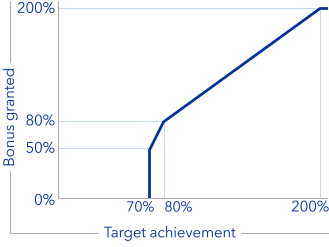
Target achievement is primarily determined based on financial, non-financial, and sustainability reporting. The achievement of non-financial targets is determined by comparing actual with target data. On this basis, the Supervisory Board defines percentage target achievement levels for the performance criteria of the Annual Bonus after the end of the financial year. The following target-achievement levels apply for each performance criterion:
The applicable components are omitted if target achievement is less than 70%.
50% of the target amount defined for the component in question is granted for target achievement of 70%.
80% of the target amount defined for the component in question is granted for target achievement of 80%.
200% of the target amount defined for the component in question is granted for target achievement of 200%. A cap is applied to target achievement of above 200%.
The intermediate values are interpolated on a linear basis.
Target Achievement Levels – Annual Bonus performance criteria
Subsequently, the total target achievement for, and the amount of, the Annual Bonus is calculated from the addition of the weighted target achievement for the individual components.
For the 2025 Annual Bonus, the Supervisory Board set the joint and individual performance targets shown in the table below at the end of 2024 and, on February 6, 2026, determined the level of target achievement (also shown below) and resulting payment amount. In view of the end of the measurement period on December 31, 2025, the 2025 Annual Bonus was “granted” to the Executive Board members in the financial year 2025 (within the meaning of § 162 (1) sentence 1 AktG), even though it will not be paid out until after the 2026 Annual General Meeting.
Annual Bonus 2025
Performance criteria |
|
Target level |
|
Actuals 2025 |
|
Weighting |
|
Actual target achievement |
|||||||||
|---|---|---|---|---|---|---|---|---|---|---|---|---|---|---|---|---|---|
Net sales growth Consumer |
|
5% net sales growth |
|
2.5% |
|
20% |
|
73%1 |
|||||||||
EBIT increase Consumer |
|
Increase in earnings before interest and taxes (EBIT) excluding special factors as % of sales to 13.6% |
|
13.6% |
|
10% |
|
100%2 |
|||||||||
Skin care in-market performance |
|
Outperformance of relevant skin care market: increase in sales of NIVEA (75% weighting) and Derma (25% weighting) above market in 2025 (index of 101.4) |
|
Index 98.4 |
|
30% |
|
37.5%3 |
|||||||||
NIVEA and Derma innovation |
|
Net sales of € 1,659 bn in 2025 through innovation projects for NIVEA and Derma |
|
€ 1,661 bn |
|
5% |
|
100.6 % |
|||||||||
Digital transformation |
|
Disproportionately high growth of e-commerce: increase in e-commerce sales by 19% (vs. 2024) |
|
20% |
|
5% |
|
108 % |
|||||||||
Granted target achievement for joint targets (payout) |
|
|
|
68%4 |
|||||||||||||
|
|||||||||||||||||
|
|
Performance criteria |
|
Weighting |
|
Target achievement |
|---|---|---|---|---|---|---|
Vincent Warnery |
|
CEO: Development of Skin Care business; driving digitalization; leading sustainability; future fit organization (including synergies with Luxury business) |
|
30% |
|
112.5% |
Oswald Barckhahn |
|
Europe/North America, Luxury: Development of business in US (Eucerin) and Europe (Deo and Derma); people and culture development (including synergies with Luxury business) |
|
30% |
|
77.5% |
Astrid Hermann |
|
Finance: Digitalization and process efficiency acceleration; development of planning process; continuing transformation of finance organization |
|
30% |
|
95.8% |
Nicola D. Lafrentz |
|
HR: Modernization of HR function, including digitalization and implementation of a global operating model; talent development with focus on succession planning and high performing teams |
|
30% |
|
118.8% |
Grita Loebsack |
|
NIVEA, China/Korea: Business performance in China; NIVEA innovations; people and leadership development (including succession pipeline) |
|
30% |
|
70.8% |
Ramon A. Mirt |
|
Emerging Markets: Contribution of innovations and new markets; business performance in key markets; people and culture development (including leadership) |
|
30% |
|
81.3% |
Patrick Rasquinet |
|
Luxury (until April 2025): Development of La Prairie and Chantecaille business; people development (including synergies with Luxury business) |
|
30% |
|
40.0% |
|
|
Target remuneration (in € thousand) |
|
Overall target achievement |
|
Bonus amount |
|||
|---|---|---|---|---|---|---|---|---|---|
Vincent Warnery |
|
500 |
|
81.3% |
|
407 |
|||
Oswald Barckhahn |
|
200 |
|
70.8% |
|
142 |
|||
Astrid Hermann |
|
200 |
|
76.3% |
|
153 |
|||
Nicola D. Lafrentz |
|
200 |
|
83.2% |
|
166 |
|||
Grita Loebsack |
|
200 |
|
68.8% |
|
138 |
|||
Ramon A. Mirt |
|
200 |
|
71.9% |
|
144 |
|||
Patrick Rasquinet1 |
|
100 |
|
56.3% |
|
56 |
|||
|
|||||||||
f) Long-Term Bonus (LTP)
The members of the Executive Board receive a multi-year bonus based on strategic financial and non-financial targets (LTP), which was redesigned with effect from financial year 2025.
The LTP makes a material contribution to advancing the company’s “Win with Care” strategy by giving the Executive Board an incentive to secure sustainable and profitable growth particularly through strengthening expertise in skin care, sustainability, digitalization, opening up new growth markets, categories, and business areas, innovations, and human resource development.
Regular LTP
From 2025, the new LTP system comprises rolling annual tranches, each with an evaluation period of four years, which will be paid out after the Annual General Meeting following the last year of this period.
Long-Term Bonus
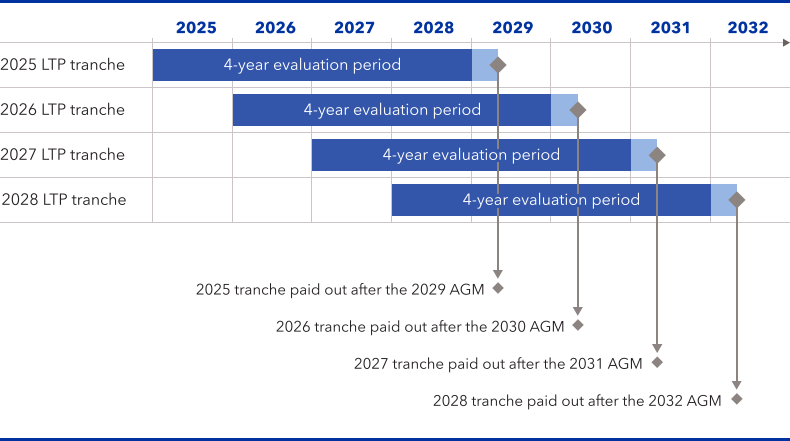
The amount of the payment from the respective LTP tranche is determined based on the achievement of financial and non-financial performance criteria, which generally comprise 90% joint targets and 10% individual targets. Alternatively, only joint targets may be determined, which are individually weighted.
The financial and non-financial performance criteria of each LTP tranche are essentially derived from implementation of the “Win with Care” strategy and the ESG materiality assessments, and defined in a measurable format before allocation of the LTP tranche by the Supervisory Board. The following performance criteria, in particular, may be used and weighted for the respective LTP tranche as determined by the Supervisory Board; the Supervisory Board is entitled to supplement and/or adjust the performance criteria at its own due discretion:
Targets/performance criteria for the LTP
The specific selection and weighting of each performance criterion, including the target value, and the target amount are determined by the Supervisory Board at the recommendation of the Presiding Committee either before or at the start of the next LTP tranche or evaluation period.
The Supervisory Board determines the achievement of the relevant targets for the respective LTP tranche at the end of the evaluation period for that tranche, and defines percentage target achievement levels between 0% and 200%. The bonus from the LTP tranche is due for payment after a further holding period until the Annual General Meeting following the final year of the evaluation period. The Supervisory Board may provide for Executive Board members to receive an advance payment on the LTP tranche before the end of an evaluation period; this is then offset against the final determined LTP tranche when it becomes due. In financial year 2025, no advance payment was granted.
The Supervisory Board determined the following performance criteria for the first LTP tranche under the new remuneration system, which was allocated for 2025 and has an evaluation period until the end of 2028 (“LTP 2025”):
Additional LTP tranches
Moreover, under the new LTP system, the Supervisory Board may provide for additional LTP tranches for individual or all members of the Executive Board, which may also have differing terms. To give a particular boost to the activation and ongoing implementation of the “Win with care” strategy, the Supervisory Board determined a one-time tranche with appropriate performance criteria with a term/evaluation period of five years (2025-2029) which will be due for payment after the Annual General Meeting in 2030 (“LTP 2025-2029”). The only Executive Board members to receive the LTP 2025-2029 in full will be those remaining with the company until the end of 2029. The target amount for the entire term of the LTP 2025-2029 is equivalent to the target amount for the respective Executive Board member for a regular LTP tranche for financial year 2025. If any Executive Board member leaves the Executive Board at the end of their service agreement before the end of 2029, the LTP 2025-2029 will be granted to them on a prorated basis. The following performance criteria were determined for the LTP 2025-2029:
If any Executive Board members were allocated additional LTP tranches or LTP target amounts in 2025, these also have a term of at least four years or in line with the appointment duration of the member in question. Target achievement is generally measured based on the average target achievement of the remaining LTP tranches at the end of the term.
The remuneration report for the financial year in which the respective LTP performance ends transparently presents and explains the specific performance criteria and metrics, the target achievement, and the resulting payment amount. Executive Board members also have the option of converting individual LTP tranches, in full or in part, into a defined contribution benefit pension commitment before they become due for payment.
Capping of the Variable and Maximum Remuneration
The amount of all variable remuneration elements (Annual Bonus, LTP) is capped at 200% of the applicable individual target amount. The amount of the maximum total remuneration pursuant to § 87a (1) sentence 1 no. 2 AktG is determined in euros on the basis of this relative cap taking into account all fixed and other remuneration components that may be granted to a member of the Executive Board depending on the individual case.
The maximum remuneration is €12 million per year for the Chairman of the Executive Board and €8 million per year for each ordinary member of the Executive Board. This maximum remuneration contains the amounts of the long-term variable remuneration (LTP) with a prorated annual value, notwithstanding the fact that several LTP tranches may become due at the same time or may have differing terms. It is not possible to report on adherence to maximum remuneration within the meaning of § 162 (1) sentence 2 no. 7 AktG until after the respective LTP tranche has been paid out. The remuneration granted and owed to the individual Executive Board members in the reporting year is compared with the maximum remuneration even if there is no payment of the long-term variable remuneration (see tables in the following section “Remuneration of the Individual Executive Board Members in 2025”).
Adjustments, Retention, and Clawback
The Supervisory Board is entitled, at its own due discretion, to raise or lower the variable remuneration by up to 20%, with the maximum limited to 200%, to reflect exceptional performance and developments, with a particular view to Recommendation G.11 of the German Corporate Governance Code. Exceptional developments in this sense may include, in particular, circumstances resulting in impacts that were unforeseen when the performance criteria were determined, and which have a significant effect on the achievement of these criteria and thus also on total remuneration. These may be material changes in business not considered in the planning, such as company transactions, restructuring, changes in tax regulations or accounting standards, or unforeseen changes in the economic environment outside the ordinary course of business. If the Supervisory Board finds such increase or decrease appropriate, it will be transparently reported in the relevant remuneration report.
Variable remuneration components that have already been determined or paid out may be retained or claimed back by the Supervisory Board if the basis for calculating the original target achievement, particularly the applicable consolidated financial statements, subsequently proves to be incorrect due to new facts or evidence (including material breaches of duty) (“clawback”). However, this possibility is barred no later than three years after payment. This does not prejudice any other remedies that the company may have to recover damages from the member of the Executive Board, particularly under § 93 (2) AktG. The Supervisory Board did not make use of this possibility in 2025.
Rules in Relation to Termination of Executive Board Members’ Duties
In the event of the premature termination of the office or activities of a member of the Executive Board for reasons beyond that member’s control, the Executive Board service agreements provide for a cap on the termination benefits or other payments of twice the value of the base remuneration and twice the value of the Annual Bonus or a cap equaling the total target remuneration for the remaining period of the service agreement.
If the contract of a member of the Executive Board is terminated, the disbursement of any remaining variable remuneration components attributable to the period up until the termination of the contract is based on the originally agreed targets and comparison parameters as well as the due dates or holding periods stipulated in the contract.
Upon the premature termination of the Executive Board member’s duties at the company’s request, except in the case of termination for good cause for reasons within the member’s control, the Annual Bonus (depending on entitlement) and the LTP (based on the financial year of departure) are granted on a prorated basis. If the member of the Executive Board resigns at their own instigation or for good cause for reasons within their own control, all claims from all LTP tranches whose evaluation periods are still ongoing at such time will lapse. Claims under the short-term Annual Bonus for the year of resignation will also lapse unless higher target achievement can be clearly demonstrated.
There are no commitments covering the premature termination of the contract of a member of the Executive Board due to a change of control.
For the duration of the post-contractual noncompete agreement, generally of 24 months, the relevant members of the Executive Board are entitled to claim compensation equaling half the most recently agreed annual base remuneration and half their Annual Bonus (subject to the offsetting of any severance payment against the noncompete compensation). The company may waive enforcement of the post-contractual noncompete agreement at any time, however no later than six months before the termination of the contract and, in the event of the contract’s premature termination, also waive this six-month period. In this respect, no compensation may be claimed.
Please refer to the following section, “Remuneration of the Individual Executive Board Members in 2025” for the specific rules applicable in the case of Patrick Rasquinet, who left the Executive Board when his service agreement expired at the end of June 2025.