
Integrated Risk and Opportunity Management System
At Beiersdorf Group, the risk and opportunity management system is an integral part of the central and local planning, management, and control processes in the individual affiliates, management units and regions, as well as functions. It applies at Consumer and tesa Business Segment levels, and at Group level. Risk and opportunity management is complemented by the accounting-related internal control systems, the various internal and external monitoring bodies, for example the Corporate Risk Board, Audit Committee of the Supervisory Board, insurance partners and Internal Audit. Compliance management, which is also relevant in this context, is described in the chapter “Non-Financial Statement.”
Risk and opportunity management (hereinafter referred to as risk management) is closely aligned with the corporate strategy and helps Beiersdorf to identify its potential and to analyse and make optimal use of this potential while always taking risks into account. Regularly performing analyses of market share, customers, and the competition, for example, enables a swift response to dynamic market developments. Specific market opportunities and risks are derived from the information obtained.
Beiersdorf actively incurs risks only if there is a corresponding opportunity for an appropriate increase in value, and only if they can be managed using established methods and measures within the relevant organization. In cases where the full avoidance of risks is not possible or reasonable, risks are mitigated using appropriate measures, or are transferred to third parties such as insurance companies.
Within the risk management process, periodic risk inventories are carried out to identify, evaluate, document, and subsequently communicate the material risks in a structured way along with the measures to manage these risks. The corresponding principles, reporting and feedback processes, and responsibilities are laid out in a directive that applies across the Group which is regularly reviewed and adjusted as necessary.
Beiersdorf Risk Presentation
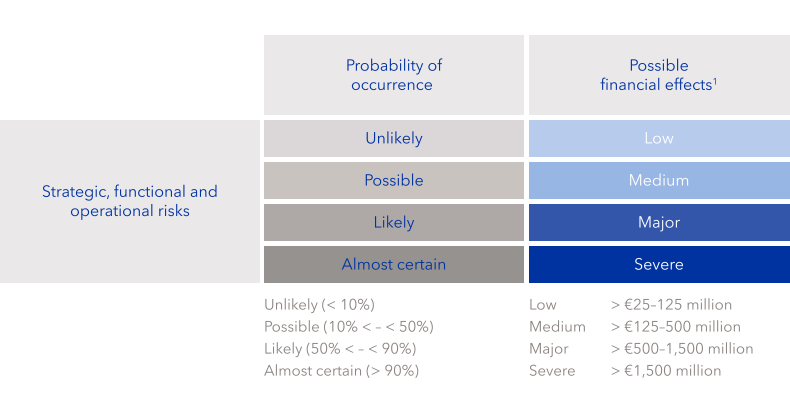
Beiersdorf distinguishes between strategic, functional, and operational risks. Strategic risks encompass fundamental frameworks, developments, and events that could have a substantial impact on the Group’s business model or its business segments. Functional risks are challenges inherent in the business model that can occur at any time with more comprehensive effects, e.g., by affecting an entire business process or business unit. They are collected and evaluated by the individual functions, for example Procurement in the Supply Chain. The various functions generally work at global or regional level to counter these risks, with sustainable actions relating to the design of operational and organizational structures as well as with specific individual measures. Operational risks and opportunities are those that may influence short-term sales and profits of our affiliates in the regions.
Appropriate observation periods are assigned to these risk categories. A period of five years generally applies for strategic risks. For functional risks, the period is two years as a rule, and for short-term operational risks one year.
The risks (within their category) are classified based on their probability and the potential financial and non-financial impact of their occurrence. While different thresholds are used in operational management to classify the financial effects according to risk type, a uniform view from the Group perspective applies from the viewpoint of the materiality of the risks with accordingly uniform thresholds. The likelihood of occurrence and impact of risks are determined on a net basis, assuming that risk mitigation measures have already been implemented or at least that specific plans for them exist.
The Executive Board and supervisory bodies are regularly updated on the risk situation at Consumer and tesa Business Segment levels and at Group level. Besides this, direct lines of communication ensure that suddenly occurring material risks are also reported immediately to management. Continuous information sharing with the Corporate Development and Corporate Controlling functions additionally encourages consideration of risk aspects in the support provided to management. The centralized risk management is also in constant communication with topic-specific task forces, which are created by the Executive Board as necessary. During the financial year 2025, however, no special teams were active covering relevant risk topics on a broader scale.
The Consumer Business Segment’s Corporate Risk Board (CRiB) continued its work in the reporting year as a key body advising the Executive Board on risk management matters. The CRiB continues to consist of the heads of important, mostly globally responsible corporate departments comprising multiple areas of responsibility (Marketing, Quality Management, Internal Audit, Communication, Sustainability, Group Accounting, IT Security, and Legal & Compliance). The task of this body is to collate the various risks – both those already known and those newly identified by the CRiB – using a broad-based approach, analyse them in depth, and present them in summarized form. By bringing together many different perspectives, it provides Beiersdorf with important collective intelligence, further improving and complementing the existing analysis of material risks.
As a standard procedure, the Executive Board and Supervisory Board dealt with the main risks and opportunities by comparing the updated, qualitatively (by allocating and bundling functional risks to strategic risks) and quantitatively aggregated risk portfolio with the financial, also updated, overall risk-bearing capacity. The aim was again to determine whether there was any need for a change in the overall assessment of the risk situation on this basis (see below). In order to assess the risk situation, the potential negative financial effects on the projected EBIT of the main risks are added together should they occur.
To ensure maximum transparency and traceability, Beiersdorf’s financial risk-bearing capacity is calculated based on average net liquidity. This method is used since it is particularly suitable for showing the short-term risk absorption capability: Liquidity (unlike equity) is available to immediately tackle a risk should it occur. The available free cash flow used for assessing the development of net liquidity in the multi-period perspective is adjusted for the previously deducted investments in securities and effects from past M&A transactions. The calculation of the risk-bearing capacity is therefore based on a very conservative approach, as it deliberately does not take into account potential significant short-term increases in our liquidity, which could be used in actual crisis situations. These increases could include, for example, new and/or increased credit lines, the release of hidden reserves, the sale of fixed assets, individual business units, or own shares from our portfolio, the temporary suspension of dividend payments, or the reduction of planned investments in the market or in maintaining or expanding our fixed assets. We used the average for the last five years’ net liquidity and cash flow to ensure that the risk-bearing capacity assessment was not too strongly influenced by short-term or one-off events.
As a result of comparing the risk situation with risk-bearing capacity, it can be concluded that, over the relevant observation period of the next two years, the current risk portfolio, revalued during the reporting year, would still not give rise to a financial situation even remotely jeopardizing the Beiersdorf Group’s continued existence, even given the full and simultaneous occurrence of all the individual risks.