
Results of Operations – Business Segments
Consumer
Consumer
|
|
|
|
|
|
Change (in %) |
||
|---|---|---|---|---|---|---|---|---|
|
|
01.01.-31.12.2024 |
|
01.01.-31.12.2025 |
|
nominal |
|
organic |
Europe |
|
3,546 |
|
3,590 |
|
1.2 |
|
0.9 |
Western Europe |
|
2,785 |
|
2,839 |
|
1.9 |
|
1.8 |
Eastern Europe |
|
761 |
|
751 |
|
-1.2 |
|
-2.3 |
Americas |
|
2,283 |
|
2,235 |
|
-2.1 |
|
3.1 |
North America |
|
1,008 |
|
997 |
|
-1.1 |
|
3.8 |
Latin America |
|
1,275 |
|
1,238 |
|
-2.9 |
|
2.6 |
Africa/Asia/Australia |
|
2,333 |
|
2,351 |
|
0.8 |
|
4.5 |
Total |
|
8,162 |
|
8,176 |
|
0.2 |
|
2.5 |
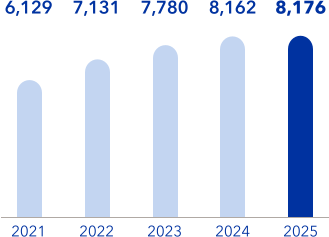
Sales in the Consumer Business Segment grew organically by 2.5% in 2025. Exchange rate effects reduced growth by 2.3 percentage points. In nominal terms, sales therefore increased by 0.2% to €8,176 million (previous year: €8,162 million).
Despite a challenging year in global markets, NIVEA (including Labello) was able to increase its market share in Japan, Mexico, Spain, and Italy. Market share losses were recorded in Germany, Poland, Thailand, and Indonesia. The Derma business unit, with the Eucerin and Aquaphor brands, increased its market share across all regions and major categories, with particularly strong developments in Brazil, Mexico, Thailand, the USA, Sweden, and Belgium. The Health Care business unit continued its positive development and grew in many core markets. With market share gains and the strong performance of its successful Hansaplast Second Skin Protection Plaster product line, it further strengthened its position as market leader.
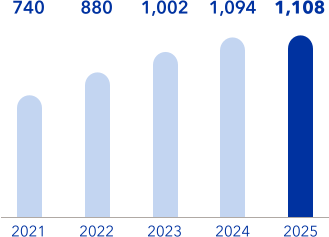
EBIT excluding special factors amounted to €1,108 million (previous year: €1,094 million), while the EBIT margin excluding special factors was 13.6% (previous year: 13.4%). The increase in EBIT compared to the previous year is primarily due to efficiency gains, which more than compensated for the gross margin development. The special factors in the Consumer Business Segment came to €39 million (previous year: €67 million). For further details regarding the composition of special factors, please refer to the table “Special Factors” in the “Result of Operations – Group” Section. The operating result including special factors stood at €1,069 million (previous year: €1,027 million), while the EBIT margin was 13.1% (previous year: 12.6%).
NIVEA (including Labello) grew organically by 0.9% globally in 2025. Nominal sales decreased from €5,601 million to € 5,529 million. The growth of the NIVEA brand was driven by price, while the volume effect had a negative impact. The brand recorded particularly strong sales growth in Nigeria, India, Turkey, Japan, and the United Kingdom, whereas France, the Netherlands, Poland, Brazil, Indonesia, and China experienced a moderate to more significant decline in sales. The main growth drivers for NIVEA were Universal Creams and NIVEA Sun.
At the product level, NIVEA Deo had a challenging year, in which the Protect & Care, Dry, and Skin Tone Management lines in particular declined. These negative developments could not be offset by the positive sales increases, for example from the launch of the NIVEA Deo Derma Control range. The launch of the new NIVEA CELLULAR Epigenetics Rejuvenating Serum marked the most significant product introduction in the NIVEA Face Care category in 2025. With strong contributions from the NIVEA Soft, NIVEA Sun Protect & Moisture and NIVEA Body Care Milk product lines, NIVEA demonstrated that it can achieve growth not only through innovative new products but also with its core products.
The Derma Business Unit recorded organic growth of 11.7% and achieved nominal sales of €1,492 million (compared to €1,372 million in the previous year). All regions and many brand categories contributed positively to sales growth. The Emerging Markets again proved to be the most important growth driver for Derma in 2025, driven by solid development in Latin America, particularly Brazil and Mexico, as well as in Thailand. North America ranked second, where all brand categories recorded growth and Aquaphor in particular achieved strong results. A decline in sales was recorded in Argentina. Overall, Derma’s success was driven primarily by innovative developments. The Eucerin face category benefited from the continued strong performance of innovations such as the Epigenetics Serum. Another growth factor was the ongoing expansion of the Thiamidol® product line, both regionally – with the introduction of Radiant Tone in the USA and of Thiamidol® in mainland China – and in terms of categories, through the strong growth figures of our innovative Anti-Pigment Body solutions. The e‑commerce sales channel once again grew faster than the offline business.
Health Care recorded organic sales growth of 9.3%, reaching €299 million (compared to €282 million in the previous year). The wound care category proved to be a key sales driver, supported by the launch of the successful Second Skin Protection Plaster range. In addition, large plasters once again recorded double‑digit growth and were able to grow in all key markets.
In selective cosmetics, our La Prairie brand’s organic sales were down by 4.5%. Nominal sales fell from €509 million to €478 million. This result is essentially attributable to challenges in China, specifically in travel retail, where the premium skincare market declined by double digits. By contrast, the e‑commerce channel continued to develop positively, with a focus on China. The market launch of White Caviar L’Extrait, Pure Gold Revitalizing Essence and the two formats of the Skin Caviar Hydro Emulsion helped to partially offset the decline in sales.
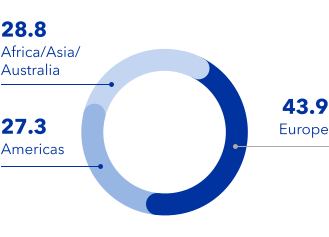
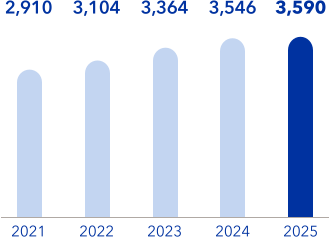
In the Europe region, organic sales were up 0.9% on the previous year. Nominal sales climbed by 1.2% to €3,590 million (previous year: €3,546 million).
In Western Europe, organic sales rose by 1.8%. In Italy, Spain and the United Kingdom, moderate growth was achieved, while France and Switzerland recorded a moderate decline. Sales in the NIVEA categories Universal Creams, Sun, and Face Care as well as in the Eucerin categories Body, Face, and Sun developed positively, whereas sales in NIVEA Deo, NIVEA Body Care, and NIVEA Body Cleansing declined slightly. The wound care category within the Health Care business unit also contributed positively to sales growth. For the La Prairie brand, the negative development of the travel retail business had a significant impact.
Sales in Eastern Europe were organically 2.3% below the previous year. Above all in Poland and Romania, sales remained below the previous year. The NIVEA Body Cleansing and NIVEA Face Care categories recorded a decline in nominal sales, while NIVEA Deo achieved slight growth. The Eucerin Face category recorded double‑digit sales growth.
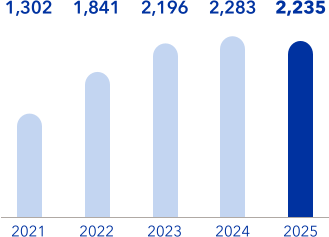
In the Americas region, organic sales grew by 3.1%. At €2,235 million, nominal sales were down to 2.1% on the previous year (€2,283 million).
In North America, organic sales growth of 3.8% was achieved. The Eucerin, Aquaphor, and Chantecaille brands emerged as key growth drivers. Coppertone’s sales remained significantly below the previous year.
Sales in Latin America grew organically by 2.6%. In Mexico, Colombia, and Chile, sales developed positively, while Costa Rica, Panama, and Argentina recorded a greater decline. The NIVEA categories Universal Creams, Body Cleansing, and Body Care achieved strong growth, whereas the Deo, Sun, and Face Care categories remained below the previous year’s level. Eucerin recorded strong development in the Body and Face categories, while the Sun category had to accept a slight decline.
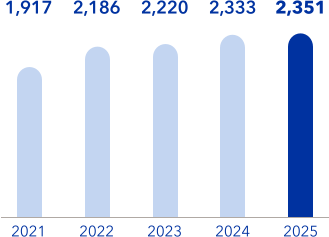
Sales in the Africa/Asia/Australia region grew by 4.5% in organic terms. In nominal terms, sales rose by 0.8% to €2,351 million (previous year: €2,333 million). Sales developed positively in Australia, Japan, Nigeria, India, Saudi Arabia, Thailand, and Turkey, while declines were recorded in China, Indonesia, and Dubai. Moderate growth was achieved in the NIVEA categories Universal Creams and Body Care, whereas the Deo category was slightly below the previous year. Eucerin also achieved strong growth in the region, especially in the Face and Body categories. Health Care additionally recorded strong development in the wound care segment.
Consumer Sales
(in € million)
Consumer Sales by Region 2025
(in %)
Consumer EBIT
Excluding special factors (in € million)
Consumer Sales in Europe
(in € million)
Consumer Sales in Americas
(in € million)
Consumer Sales in Africa/Asia/Australia
(in € million)
tesa
tesa
|
|
|
|
|
|
Development (in %) |
||
|---|---|---|---|---|---|---|---|---|
|
|
01.01.-31.12.2024 |
|
01.01.-31.12.2025 |
|
nominal |
|
organic |
Europe |
|
767 |
|
757 |
|
-1.3 |
|
-1.5 |
Americas |
|
284 |
|
270 |
|
-4.9 |
|
-0.2 |
Africa/Asia/Australia |
|
637 |
|
649 |
|
1.9 |
|
6.6 |
Total |
|
1,688 |
|
1,676 |
|
-0.7 |
|
1.8 |
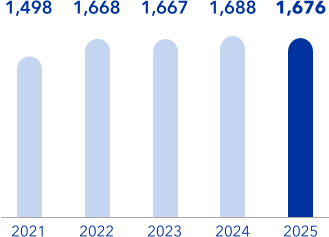
tesa achieved organic sales growth of 1.8% in 2025 in a challenging market environment. Exchange rate effects dampened this performance by 2.5 percentage points. Nominal sales decreased year on year from €1,688 million to €1,676 million.
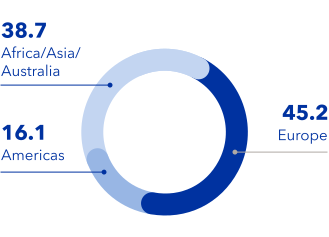
In Europe, sales were below the previous year’s level, with an organic decline of 1.5%. The challenging market environment and stagnating development in Europe meant that there was no increase in sales in business with industrial customers in most sectors. The challenging market environment was reflected in the automotive sector in particular. The performance of the consumer goods business was marked by ongoing price pressure in 2025. Demand remained subdued amid economic uncertainties, elevated interest rates, and continued cost-of-living pressures. In nominal terms, tesa achieved sales of €757 million in Europe (previous year: €767 million). The region’s share of Group sales fell to 45.2% (previous year: 45.5%).
In North and South America, organic sales were slightly below the previous year’s level (-0.2%). Business performance was mixed; in North America, tesa recorded sales growth in the printing and packaging sectors, while the electrical systems business was significantly impacted by price pressure and inventory reductions by major customers. Automotive also continued to be impacted by US tariffs and did not achieve sales growth. In South America, business with industrial customers achieved solid growth, while business with end customers was below the prior-year level. The region’s sales decreased to €270 million in nominal terms (previous year: €284 million). The region’s share of Group sales fell to 16.1% (previous year: 16.8%).
In Asia, tesa achieved organic sales growth of 6.6%, particularly due to new project business with products for the electronics industry. Business developed particularly positively in high-growth markets such as South East Asia. In nominal terms, sales in Asia increased to €649 million (previous year: €637 million). The region’s share of Group sales rose to 38.7% (previous year: 37.7%).
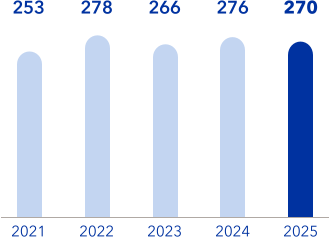
At €270 million, EBIT excluding special factors was below the previous year’s level (previous year: €276 million). The EBIT margin excluding special factors was 16.1% (previous year: 16.3%). The special factors in the tesa Business Segment amounted to a total of €-19 million (previous year: €-9 million). For further details regarding the composition of special factors, please refer to the “Special Factors” table in the “Results of Operations – Group” section. EBIT excluding special factors was negatively impacted by a decrease in the gross margin and exchange rate effects. This was partially offset by cost-saving measures, particularly in Marketing and Sales.
The operating result including special factors amounted to €251 million (previous year: €267 million), while the EBIT margin was 15.0% (previous year: 15.8%).
tesa Sales
(in € million)
tesa Sales by Regions
(in %)
tesa EBIT
Excluding special factors (in € million)
In consumer electronics, tesa once again recorded an increase in sales and expanded its position as a key supplier of innovative products and solutions for the manufacture of smartphones and tablets. The product ranges for mounting front and rear modules, solutions for battery bonding, and conductive adhesive tapes were further developed and converted into customized solutions.
In printing and packaging, tesa further expanded its activities, particularly with adhesive tapes for splicing paper and in the flexographic printing market segment, thereby achieving solid overall growth. Despite a subdued global market environment, significant growth was achieved in North America and Latin America.
The automotive business remained at its prior-year sales level in 2025. Despite a globally stagnant market environment, tesa achieved significant sales growth in China and Latin America and increased its market share. Particularly successful customer projects relating to automated adhesive tape solutions for car body construction (hole closure) and products for door seals contributed to this development. In North America, however, the declining market – especially in the electric mobility sector – had a negative impact, resulting in a decline in sales compared to the previous year.
The electrical systems business was also affected by this development and recorded sales declines in both North America and China. In North America, the decrease was driven primarily by lower production volumes, while in China strong price pressure weighed on the development. Globally, a slight increase in sales was achieved.
The industrial trade business was also characterized by subdued demand in 2025, with sales slightly above the previous year’s level. The optimization and expansion of sales structures in China led to positive sales development. Due to the challenging market situation in Europe, Asia, and North America, it was not possible to match the previous year’s sales in these regions for the industrial trade business. The transformation of the product range towards sustainability had a positive effect.
Despite the challenging market environment in Europe, business with end consumers and professional tradespeople grew moderately overall.
The main growth drivers in terms of product range were self-adhesive fastening solutions and sealing tapes, such as tesamoll, while sales of repair and packaging tapes as well as bathroom accessories declined.
In terms of sales channels, the retail business and e-commerce business in particular grew. Business with professional tradespeople declined against the backdrop of a market environment characterized by a downturn in the construction industry, and the stationery segment also performed below the previous year’s level.