
Economic Environment
General Economic Situation
Gross Domestic Product1
Change versus previous year (in %)
Inflation Rate1
Change versus previous year (in %)
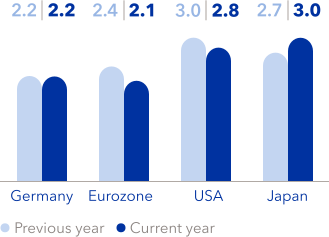
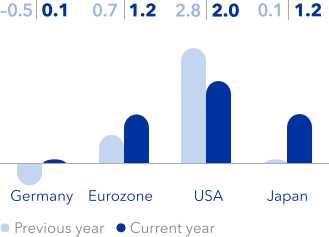
The global economy recorded only moderate growth in 2025, which was characterized by varying developments in the major economic regions. In the USA, the economy remained solid, supported by a robust domestic economy. Growth in the eurozone was subdued, although sentiment indicators brightened and investment activity increased. In Germany, the recession ended, but the recovery remained fragile against a backdrop of structural challenges and external pressures. In China, the growth trend continued to weaken as ongoing problems in the real estate sector and weak domestic demand slowed the economy. Overall, inflation declined only slowly in many economies. While falling energy prices provided some relief, inflationary pressures remained persistent overall.
Economic development in the eurozone was mixed in 2025. While moderate growth was recorded, overall momentum remained subdued. Development varied from region to region, with countries such as Germany and Spain showing signs of momentum, while others, such as France, continued to struggle. Business sentiment brightened significantly, reaching its highest level in over two years, driven by service providers and rising investment due to lower key interest rates. However, weaker exports due to US tariffs weighed on industry. Inflation settled close to the ECB’s target. Rising collectively agreed wages drove up prices, while energy prices and imports mitigated inflationary pressure.
The economic situation in Germany improved slightly in 2025, but remained characterized by uncertainty. Sentiment indicators rose and the recession came to an end. Sentiment improved particularly in industry, despite stagnating order intake, while the construction sector showed a slight upward trend, but residential construction did not experience any sustained recovery. The ECB lowered its key interest rates last year, the effects of which should gradually begin to have a positive impact. Private consumption increased moderately, but remained too weak to noticeably improve the overall economic situation. Higher US tariffs and weak demand from China further dampened exports.
Economic development in the USA remained solid in 2025. Robust private consumption and dynamic investment, particularly in artificial intelligence infrastructure, contributed to growth. The government shutdown is likely to have slowed growth in the short term. However, the economy remained stable overall. Despite high key interest rates, financing conditions remained favorable overall, partly due to expected interest rate cuts. Inflation was subdued overall, and the impact of tariffs has been milder than expected so far. However, import-dependent goods are showing above-average price increases. The US Federal Reserve gradually eased its interest rate policy.
In 2025, the Japanese economy experienced robust growth, driven by strong domestic demand. While exports and residential construction investment declined temporarily, private consumer spending and corporate investment remained robust overall. Despite US tariffs, exports to non-US markets and tourism sustained activity. Nevertheless, temporary weaknesses in exports and residential construction investment led to mixed results in the third quarter. The economic stimulus package adopted in the fall, with investments in AI, semiconductors, and defense, contributed to stabilizing and modernizing the economy.
Developments in emerging markets presented a mixed picture. In 2025, China’s economy remained under pressure. Domestic demand remained subdued, even though state-owned banks and local governments were allowed to issue more bonds to support investment projects. While industry benefited from strong exports, structural problems such as the bloated real estate sector and local government debt prevented a broad-based recovery. This was compounded by geopolitical tensions and higher US tariffs, which weighed on foreign trade. The Brazilian economy remained robust in 2025. Private consumption lost momentum, while investment was held back by high interest rates and uncertainty. Agriculture remained an important driver of growth. The central bank tightened its monetary policy in response to persistent inflationary pressures. Economic development in the Middle East accelerated in 2025. Despite ongoing conflicts and oil production cuts, higher oil production in GCC countries and strong results in Egypt mitigated the negative effects. US tariffs had an indirect impact through a subdued global economy and commodity prices. The Indian economy remained dynamic in 2025. Private consumption and investment drove growth, supported by falling interest rates and public capital expenditure. This was reflected in strong GDP growth and low inflation, supported by good harvests and falling energy prices. However, US tariffs weighed on exports. In the emerging economies of Southeast Asia, momentum remained high in 2025, but cooled slightly due to US tariffs.
Sales Market Trends
Consumer
Consumer
Consumer Spending1
Change versus previous year (in %)
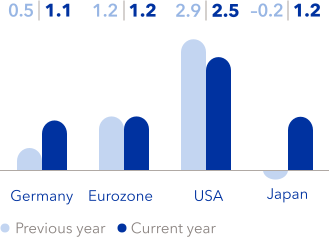
The global economic environment in 2025 remained challenging. Supply chain pressures eased, but geopolitical tensions and trade disruptions continued to affect material availability and costs. Inflation moderated in key markets, yet elevated interest rates and currency fluctuations weighed on consumer spending. Globally, skin care markets slowed down significantly, showing a low single-digit growth in recent periods. Local and indie brands1 increased their market share, while major manufacturers faced pressure. The European mass market showed resilience, supported by volume and mix improvements rather than price increases. In North America, mass and Derma segments expanded steadily, driven by strong performance in body care and the growing influence of challenger brands. Growth softened across many emerging markets and consumers became increasingly value conscious. At the same time, shoppers are more digitally connected than ever, fueling strong eCommerce growth and reshaping purchase behaviors. Premium skin care faced global headwinds, with Asia — particularly China and Travel Retail — contributing to the decline. Discretionary spending remained under pressure, and travel retail weakened, creating a more competitive environment for luxury brands.
tesa
tesa
tesa was shaped by a persistently challenging and volatile global environment in financial year 2025. Growth remained subdued despite a moderate decline in inflation and an easing of monetary policy. Geopolitical tensions – in particular the war in Ukraine and escalations in the Middle East – combined with economic uncertainty in China and North America exacerbated by new US tariffs, are increasing supply chain and production costs. The labor markets in industrialized nations remain tense, while rising raw material, and wage costs perpetuate cost pressure. Automotive production has stagnated, not least in Europe, due to trade barriers (including US tariffs), following a weak growth in 2024. The electronics markets have made a moderate recovery thanks to stable demand for PCs and tablets, as well as investment in AI, although growth in consumer electronics has been only slight. Other industrial markets are suffering the effects of uncertainty, price pressure, and high interest rates, which are dampening demand in Europe and North America. After the sharp price increases of recent years, the consumer goods market remained under considerable price pressure in 2025. There has been little recovery in demand in developed markets, particularly in Europe, due to economic uncertainty, high interest rates, and the rising cost of living.
Procurement Market Trends
The situation in important markets for materials and services continued to ease in 2025. This was due to the subdued global economy, especially the continued lower-than-expected growth in China and Europe, and declining energy prices and inflation. The prices for raw materials and primary products fell again on average. The palm oil market was once again an exception, experiencing a shortage due to structural supply bottlenecks and fluctuating harvest volumes in Southeast Asia caused by unfavorable weather. This led to higher prices for palm oil and palm oil-based raw materials. This once again improved procurement environment compared to the previous year, combined with consistent bottleneck management and preferred partnerships with strategic suppliers, enabled us to further reduce and largely avoid supply bottlenecks.
Overall Assessment of the Economic Environment
The global cosmetics market developed overall more subdued in 2025, with a declining growth dynamic compared to the previous year, in a still challenging macroeconomic environment. In the mass market, in which NIVEA is active, growth continued to be driven primarily by volume increases, while the contribution from price increases continued to decline. In individual regions, particularly in Latin America and Eastern Europe, the market development was subdued compared to other regions. The dermocosmetic skin care market saw a clear slowdown in growth, in line with the overall market deceleration, although it continued to be supported by the sustained demand for science‑based products. Skin Care remained the most important growth and focus category within the Consumer Business Segment in 2025 and continued to be at the center of marketing investments.
In the tesa Business Segment, 2025 continued to be shaped by economic and geopolitical uncertainty, with prices remaining high in some regions, causing a slump in private demand. The global economy proved resilient, but remained below the pre-crisis level due to the strain of trade wars, new US tariffs, geopolitical tensions, and fragmented supply chains. The Executive Board of the tesa Business Segment considers the market environment to be volatile; nevertheless, tesa achieved growth – primarily in key industries such as electric mobility and electronics – thanks to innovative strength, adaptability, and targeted investment. tesa also succeeded in further expanding the share of sustainable adhesive solutions and adhesive solutions using sustainable materials.
1 Are often independent brands that have a clear unique identity, and are frequently run by local or specialized companies.