
The Role of the Administrative, Management, and Supervisory Bodies
-
General Disclosures
As required by law in Germany for stock corporations (Aktiengesellschaften), Beiersdorf AG has a dual management and supervisory structure consisting of the Executive Board and the Supervisory Board.
Executive Board
Our Executive Board takes sole responsibility for managing the company and conducting the company’s business. It performs its duties in the company’s best interests and is dedicated to sustainably increasing the enterprise value. The members of the Executive Board are appointed by the Supervisory Board. An Executive Committee was established to support the operational control of the Beiersdorf Group’s Consumer Business Segment. This comprises the members of the Executive Board and two individuals with global management functions.
The Beiersdorf Group Executive Board has six members, in 2025 50% of them were female (Astrid Hermann, Nicola D. Lafrentz, and Grita Loebsack).
Collectively, all members of the Executive Board must possess extensive relevant international experience acquired from years of working abroad or special expertise in our key international markets. Sector-specific knowledge is also required.
Primary responsibility for sustainability matters within the Executive Board lies with the Chairman of the Executive Board, Vincent Warnery, and Labor Relations Director Nicola D. Lafrentz. Within the Executive Committee, Dr. Gitta Neufang (Chief Research & Development Officer) and Michael Frey (Chief Supply Chain Officer) also have environmental, social, and governance (ESG) expertise. Dr. Gitta Neufang is also a sponsor of the Sustainability Council, the cross-functional management body for material sustainability matters in the Consumer Business Segment (see “ESG Governance” section of this chapter).
Supervisory Board
Our Supervisory Board comprises twelve members. In 2025
58% were female,
50% of shareholder representatives and 100% of employee representatives were independent within the meaning of the German Corporate Governance Code in the opinion of the Supervisory Board, and
six members were employee representatives.
The Supervisory Board ensures that its members collectively have the knowledge, skills, and professional experience needed to perform their duties properly. In terms of their expertise, the members must collectively, in accordance with § 100 (5) Aktiengesetz (German Stock Corporation Act, AktG), be familiar with the sector in which the company operates; in addition, there must be at least one member with expertise and experience in each of the following specific areas:
Business areas and sectors (consumer goods, beauty and skin/body care, international markets, including emerging markets)
Marketing and Sales (brand development and management, distribution and retail, communication and media)
Research and Development (R&D), including innovation management
Supply Chain (supply chains and production)
Human Resources and Organization (personnel development and management, corporate organization, corporate culture, diversity)
ESG (sustainability, corporate social responsibility, ethics)
Law and Governance (law, compliance, auditing, regulatory law, corporate governance)
Information Technology (IT) and Digitalization (digitalization, data management, IT, and IT security)
Finance (finance and controlling, accounting and auditing, each including sustainability reporting, risk management, and internal control systems)
The Supervisory Board therefore has the expertise necessary for effective management of the material impacts, risks, and opportunities identified. These fall under topics including climate change, environmental protection, circular economy, personnel development, social responsibility, and corporate governance. Donya-Florence Amer has been responsible for ESG matters within the Supervisory Board since 2024.
Compliance Management
The Executive Board is responsible for establishing and monitoring an appropriate compliance management system (CMS). Both business segments, Consumer and tesa, have implemented CMS that conform to uniform standards and are implemented in close coordination with their Corporate Compliance departments for all Consumer and tesa subsidiaries. The Corporate Compliance departments are also responsible for developing and monitoring the CMS and defining minimum standards for our compliance programs.
The Corporate Compliance departments of Consumer and tesa report annually to the Executive Board and the Supervisory Board on the Group-wide effectiveness of our CMS as well as progress on other compliance issues such as anti-corruption. To this end, compliance incidents and the implementation status of our compliance programs are recorded centrally and in our subsidiaries worldwide. The results are used to identify any further action required, with appropriate measures implemented by the Corporate Compliance departments to ensure continual improvement. Reports on selected compliance issues are also submitted to the Executive Board during the year.
In addition to these reports, the Executive Board and Supervisory Board receive regular information and training on fundamental compliance issues and legal aspects.
Further information on the CMS is provided in the chapter “ESRS G1 – Business Conduct.”
ESG Governance
The Executive Board chaired by Chief Executive Officer (CEO) Vincent Warnery is responsible for approving the sustainability strategies and the Group targets they involve. It delegates implementation of the sustainability strategy to the Corporate Sustainability function, headed by Vice President Sustainability Jean-François Pascal, and the sustainability experts within the brands and functions, who report to the Executive Board on a monthly basis concerning implementation of the strategies and progress made in terms of targets and milestones.
In addition, the Executive Board is responsible for ensuring internal control and risk management that is commensurate with the business activities and risk situation. This includes sustainability-related targets relevant to the company. The Executive Board provides the Supervisory Board with regular, timely, and comprehensive reports (approx. three to five times a year and additionally in urgent cases) on all questions of relevance to the company, also regarding sustainability in particular, and explains discrepancies between the actual course of business and the planning and targets.
The Supervisory Board appoints, advises, and supervises the Executive Board in connection with the latter’s management of the company, as laid down by the law, the Articles of Association, and the bylaws. This also includes sustainability matters. The Supervisory Board and Executive Board work closely together to make a positive contribution to society and to achieve sustainable added value.
ESG Governance (Consumer Business Segment)
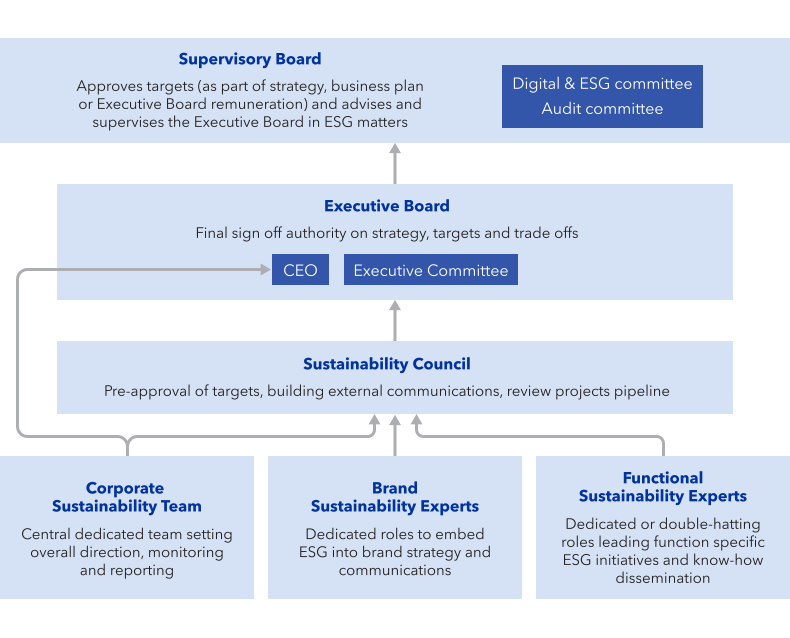
The Digital and ESG Committee, comprising three shareholder representatives and three employee representatives from the Supervisory Board, advises and supervises the Executive Board in its business conduct with respect to sustainability matters. These include strategies, targets, and initiatives relating to climate and environmental impacts, circular economy, social matters, human rights, and the commitment to an inclusive society along the entire value chain and beyond. The Digital and ESG Committee also supports the Presiding Committee in preparing the ESG targets to be set for Executive Board remuneration.
The responsibilities for monitoring sustainability matters are incorporated into the duties and offices of the Executive Board and Supervisory Board. These responsibilities are set out in our Corporate Governance Guidelines, in which the obligations with regard to the monitoring and management of sustainability matters are described in detail.
To ensure that the members of the Executive Board and Supervisory Board have sufficient sustainability-related knowledge of the identified material impacts, risks, and opportunities, they receive specific training as needed, usually once a year.